Where to Stay in Seoul — Which District Fits Your Trip
Seoul is large but the subway is dense, so the question is not how far your hotel is from things. It is which side of the river you are on, and which lines your station serves. Get that wrong and you will spend forty minutes and two transfers reaching somewhere that looked close on the map.
Most first-time visitors spend their days north of the Han River — palaces, markets, the old city — and most business travel happens south of it. Choosing a base on the wrong side is the single most common mistake.
How we choose the stays on this list
- Which lines the nearest station serves, and how many transfers to the places you actually named
- Whether Incheon Airport is reachable without changing trains
- What stays open after 9pm within walking distance
- Realistic room configurations above two people — this is the tightest constraint in Seoul
- Drawbacks raised repeatedly in guest feedback, not by one reviewer
The districts
Myeongdong is the default first-trip base and it earns that for a reason: it sits centrally, the palaces and the old city are reachable without a long ride, and the street-level density means you are never far from food or a pharmacy. The trade-off is that it is heavily tourist-facing — prices at street level run higher and it can feel crowded rather than local.
Hongdae is the university and live-music district, and it is the one area where the evening genuinely runs late. It also sits on the airport line, which makes arrival and departure simple. Pick it for nightlife and independent food; avoid it if you want quiet, because the noise is the point.
Gangnam is business Seoul — wide blocks, newer buildings, upscale dining, and the highest concentration of corporate offices. It is efficient if your reason for coming is south of the river. It is also the least walkable of these districts at street level: the blocks are long and the distances between things are real.
Jamsil works for families. The theme park, the tower and the riverside parks are concentrated in a small area, so a day can happen without transport. It is further east than the others, which is fine if you are staying put and costly if you are commuting into the old city every morning.
Seoul Station is the transit choice rather than the atmosphere choice. It is where the airport train and the intercity high-speed rail meet, so it makes sense for early departures or a trip that continues to another Korean city. As a place to spend evenings it is the weakest of the five.
Worth knowing about Seoul
Rooms for three or more are genuinely scarce outside the larger international properties, and Korean hotels enforce occupancy limits more strictly than you may expect. If your party is above two people, confirm the room configuration before booking rather than assuming an extra bed is available.
The airport connection differs by district in a way that matters on short trips: some areas connect directly, others need a transfer with luggage. We note this per property rather than describing the city as a whole, because the difference is the arrival day.
Hotels in this city
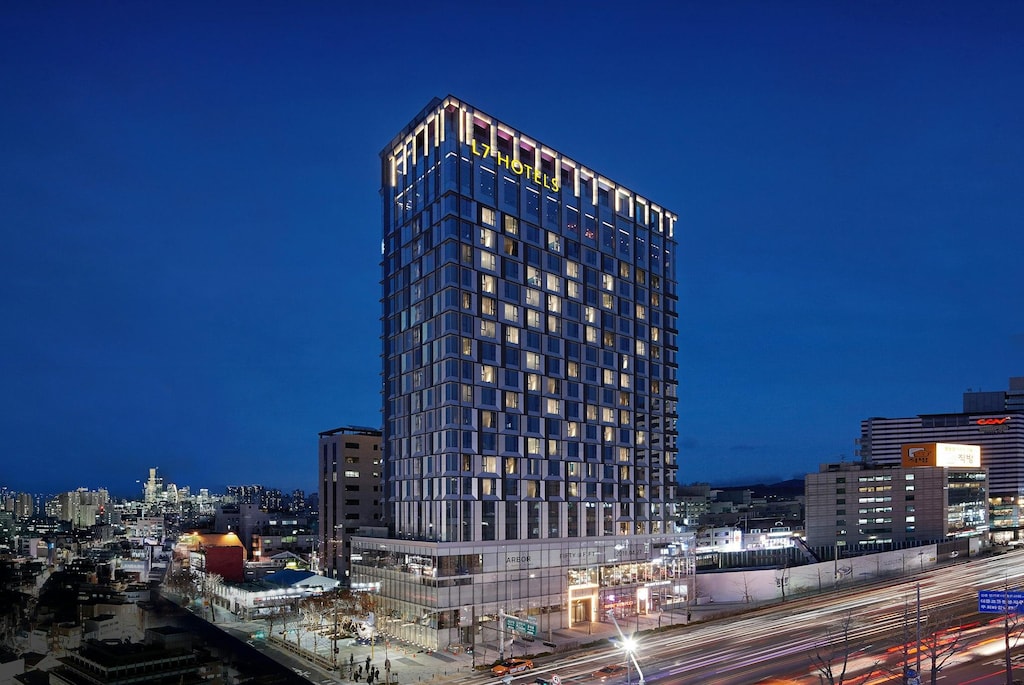
- L7 Hongdae Seoul Review: Is 240m From the Airport Line Worth It?
Hongik Univ. Station is 240m away and it is on the line that runs to Incheon Airport — so arrival and departure days stay short. The bathroom layout is the thing to check before booking.